
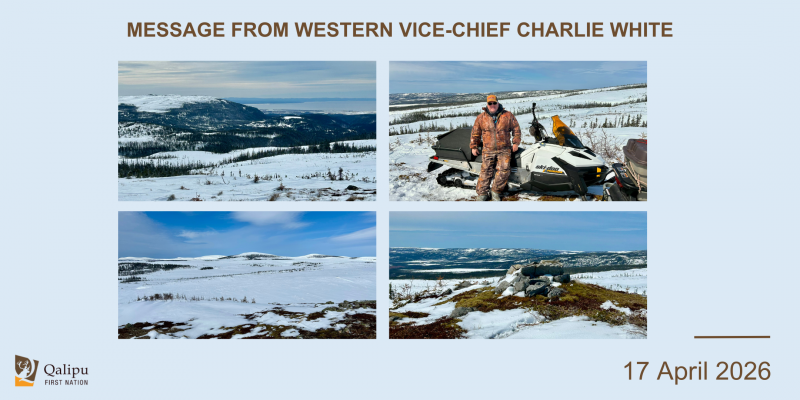
I want to share some of the work I’ve been involved in recently and the shifting conditions I am witnessing on the land. At this time of year, the landscape is transforming rapidly. With the snow melting and brooks opening up, travel is becoming unpredictable. I urge everyone out on the land to be cautious, the snow is deteriorating and no longer holding, and conditions can shift without warning. Please ensure someone knows your route and your expected return time.
Recently, I have been involved in wildfire resilience planning with the City of Corner Brook to help communities prepare for these changing conditions. Alongside this work, I have also been working through the Environment and Natural Resources department and engaging in early discussions with partners such as Kruger. Kruger currently has a five-year operational plan in place, and while a “Two-Eyed Seeing” approach is not part of that existing plan, conversations are beginning to explore how we can move in that direction in the future. This represents an initial step toward building stronger relationships and improving how forest resources are managed and waterways are protected over time.
This work reinforces the importance of ensuring the Nation is at the table from the very beginning of any project or environmental assessment. When our knowledge is included from the outset, it helps ensure that lived experience shapes decisions before they are finalized, rather than being sought as an afterthought. True partnership means being involved at the design stage to help protect sensitive habitats and culturally significant areas before work begins. This is essential to ensuring development respects the land we all rely on.
We are already seeing the effects of a changing climate. Lower water levels and altered fish habitats are clear signs of how sensitive these ecosystems have become. My work with Fisheries and Oceans Canada on brook trout populations is personal for me. I grew up fishing these waters when they had clean rock beds and steady flows. Today, warmer temperatures and reduced forest cover are changing that reality. When we lose the canopy along riverbanks, the water loses its protection.
All of these changes are connected. When landscapes are disturbed, water moves faster and erodes more easily, contributing to the flooding we are now seeing. Healthy natural areas along our rivers and streams are our strongest defense, acting as a buffer that protects water quality and builds flood resilience. The land is changing, but it continues to teach us. Our responsibility is to listen, adapt, and ensure we are protecting these resources for the generations to come.