Message from the Chief to Qalipu First Nation Membership Dear Qalipu First Nation members,
I am writing to you on behalf of your Council to acknowledge the hurt and concern caused by the recent targeted harassment directed at Qalipu First Nation, our members, and our staff. We know that harmful messages, direct calls, online posts and recordings, and physical materials have a real effect on people’s sense of safety, dignity, belonging, and wellbeing.
Please know this: Chief and Council are taking this seriously. No one should be targeted at work, at home, in their community, or online because of their Mi’kmaq identity or connection to Qalipu First Nation.
We have activated a coordinated response to protect our people and pursue accountability. This includes workplace-safety measures for staff, confidential reporting and support for people who have been affected, preservation of evidence, reports to online platforms and the appropriate authorities, and legal review of all available options. Where the evidence supports it, we will pursue appropriate action through police, platform, legal, and other lawful channels.
Our priority is the safety and wellbeing of our members and staff. We are not going to amplify harmful content or engage in online arguments. We will continue to communicate directly with you, our membership, through Qalipu First Nation’s official channels, and we will provide updates as they can be shared without compromising anyone’s safety, privacy, or an active process.
It is also important to be clear about who we are. We as Mi’kmaq people have deep and enduring connections to Ktaqmkuk. Mi’kmaq oral history records a presence on the island since the 1400s, if not earlier. Historical sources document Mi’kmaq families hunting, fishing, and trapping along the southwest coast and toward Placentia Bay during the 1600s, and records of Mi’kmaq presence become more frequent in the 1700s. In May 1767, during the survey of St. George’s Harbour, a record from Captain Cook’s expedition noted meeting “a tribe of the Mickmak Indians”.
Canada’s formal recognition of Qalipu First Nation in 2011 did not begin the story the Mi’kmaq people of Newfoundland. It recognized an elected government of our people and our communities with a history, kinship, culture, and connection to this island that long predate 2011. Our members’ identity and belonging are not for a social media misinformation campaign to decide.
We welcome respectful, good-faith dialogue and remain committed to respectful relationships with our relations across Mi’kma’ki and Turtle Island. Harassment, intimidation, falsehoods, and targeted abuse are not dialogue, and they will not define who we are.
If you receive an abusive or threatening call, message, post, or recording, please do not engage. Preserve the details if it is safe to do so: take screenshots, record the date and time, save the link or caller information, and report it confidentially to communications@qalipu.ca. If there is an immediate threat or you fear for your safety, call 911.
We also recognize that seeing or experiencing this content can be upsetting, even when it is not directed at you personally. Support is available:
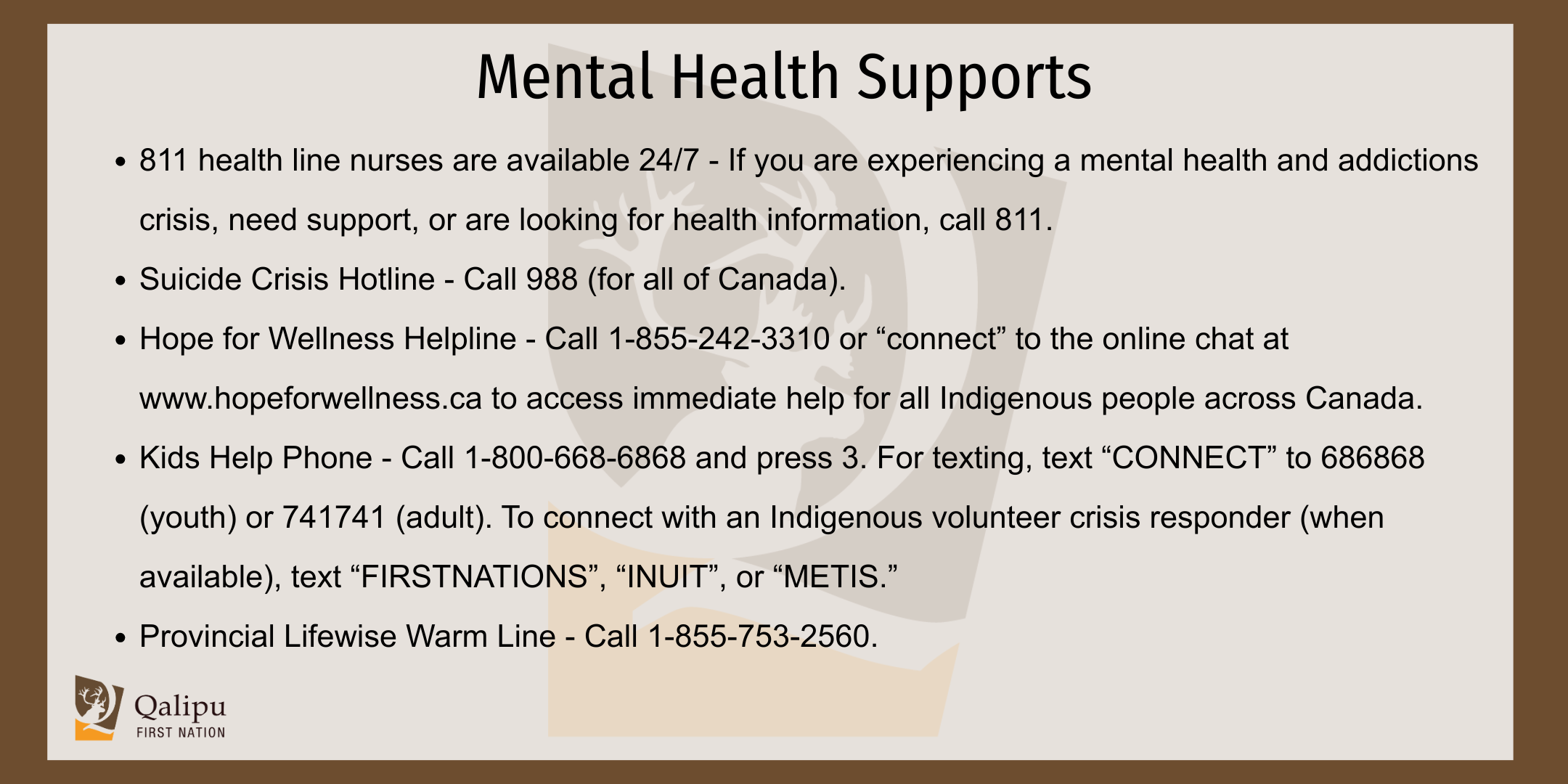
- 811 HealthLine: Call 811. Nurses are available 24 hours a day, 7 days a week. If you are experiencing a mental health or addictions crisis, need support, or are looking for health information, call 811.
- Suicide Crisis Helpline: Call or text 988, anywhere in Canada, 24 hours a day, 7 days a week.
- Hope for Wellness Helpline: Call 1-855-242-3310 or use the online chat at www.hopeforwellness.ca for immediate, culturally grounded support for Indigenous people across Canada.
- Kids Help Phone: Call 1-800-668-6868 and press 3. Text CONNECT to 686868 for youth or 741741 for adults. To request an Indigenous volunteer crisis responder when available, text FIRSTNATIONS, INUIT, or METIS.
- Provincial Lifewise Warm Line: Call 1-855-753-2560.
We are a family, and through challenging times, it is essential that we remain strong, united, and steadfast. Let us be reminded of the resilience that has always defined this place and the strength passed down to us by our L’nuk ancestors. I hear your concerns, and together with Council, we will do everything possible to support and advocate for this Nation.
Please look after one another. Reach out if you need support, share concerns with us through our confidential reporting channel, and rely on Qalipu First Nation’s official communications for verified updates.
Nmultes and wela’liek,
Chief Jenny Brake
Chief, Qalipu First Nation
On behalf of Chief and Council