March 6 (2)

Message from Chief Jenny – March 6, 2026

This week’s announcement about the Bay du Nord project and the benefits agreement between the Province and Equinor marks an important moment for our province. Projects like this have real implications for the future of offshore work in Newfoundland and Labrador, and for the workers and families who rely on that sector.

Many of our own people work in the trades and offshore, and many of us have built our lives around that work. My own experience in the trades taught me just how much major industrial projects can mean for workers, families, and the communities that depend on them.

As this project moves ahead, it’s important to us that Indigenous people are meaningfully included, and that our members have real opportunities to take part in the jobs, contracts, and economic activity that come with projects of this scale.

As your Nation, our priority is to lead projects in a way that balances economic growth with environmental responsibility. By uplifting traditional knowledge and community voices, we can help ensure that development is done responsibly, protecting our lands and waters for future generations.

We continue to invest in our people. Every year, we put significant resources into education, training, and workforce development so our members can build careers in offshore energy, marine services, and the skilled trades. We’re also exploring partnerships with industry to help strengthen the workforce needed for future growth here in Newfoundland and Labrador.

We’re investing in the marine sector as well. Newdock, Canada’s first Indigenous‑owned shipyard, is positioned to support offshore development through fabrication, maintenance, and other marine services. As offshore activity increases, facilities like Newdock can play an important role in supporting the work that surrounds major projects, including barge construction, maintenance, and other essential services.

Projects like Bay du Nord have the potential to create benefits across many sectors and throughout the supply chain. Our focus is making sure we, as a people, are ready and well positioned to take part in those opportunities as they come, while leading in a way that respects both our environment and our communities.

Feb 27v2

Message from Chief Jenny – February 27, 2026

This week, Memorial University released its Indigenous Verification Policy. This has been an important topic of conversation in our community ever since the departure of their former President, when the university publicly committed to “doing better.” When institutions speak of Indigenization and building policies that concern our communities, it can sound hopeful. However, hope only means something when it is executed with respect and accountability. While efforts have been made to improve relationships between academic institutions and First Nations, Inuit and Métis nations, we continue to see examples where universities create policies but resulting practices do not align with the very words of the institutions that write them.

We have experienced this with MUN’s compliance with its own research policy, where the governing bodies and processes of Section 35 Rights-Holding First Nations in Ktaqmkuk are often bypassed. Researchers choose convenience over proper protocol during research in our territory. During the development of the Indigenous Verification policy, MUN relied on a few recorded conversations, which do not constitute meaningful consultation with our Nation. This approach falls short of the standard of engagement we expect with our Council and membership.

I also want to be clear about something that matters deeply to us in relation to this newly adopted policy: we do not speak on behalf of the Innu or the Inuit of Labrador, nor do they speak for us. Doing so would be extremely inappropriate and disrespectful. Their identities, histories, and territories are their own. We respect them as distinct Indigenous peoples with their own governance. We have enough experience with governments deciding who we are to know the harm that causes.

For many of our families, the struggle to hold onto identity has been painful and complicated. Some of our ancestors hid who they were to protect their children. Others held on stubbornly, even when it cost them. Many of us grew up piecing together our stories from memories, old letters, and the quiet strength of those who refused to let our culture disappear. That history lives in us. It shapes how we move through the world and why we are so protective of our identity today.

This is why Memorial’s track record on implementing policy concerning Indigenous nations gives us pause. When research takes place without proper compliance to protocol in a good way or when identity is referenced without understanding the trauma behind it, it reopens wounds that our families have carried for generations. It is hard enough that Canada still asserts control over our membership through the Indian Act. Despite reassurances from MUN about their intent, we cannot allow educational systems to take on that role as well.

As your Chief, I want to assure you that your Council is fully committed to protecting our identity, our stories, and our right to define ourselves. Our culture is not something to be measured, ranked, or validated by outside structures. We will remind institutions that our people are not research subjects or policy categories; we are a living Nation with a long history and a strong future. We must continue to walk this path together, with compassion for one another and pride in who we are.

Feb 20-long

Message from Chief Jenny – February 20, 2026

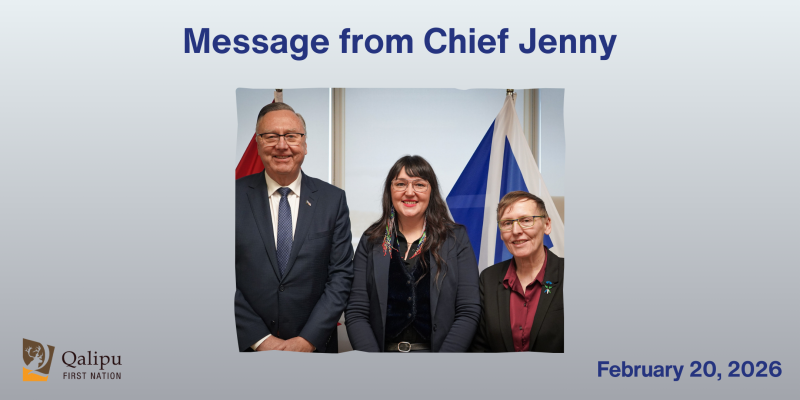
This week, members of our Executive team and I had the opportunity to meet with provincial Ministers, as well as our new Premier.

Our goal was simple, to introduce ourselves, to build early relationships to set a respectful path forward. We reaffirmed to our newly elected officials that as an Indigenous government, we offer a great deal as partners in building capacity across all sectors. We all agreed that the strength of our Nation along with collaboration of the provincial government can only be a benefit to us all—as long as we work together.

We also had the opportunity to visit the Food Fish and Allied Workers Union (FFAW) office to discuss various issues that concern the members we both represent. QFN is committed to being accountable for our words and actions and expect the same from our partners. Our role as stewards of the lands and waters is not meant to prevent economic development, but to secure it for our future generations.

From there, I went on to meet with the Atlantic Policy Congress Chiefs for two full days of important discussions regarding housing, policing, health, and economic development. Our National Chief Cindy Woodhouse Nepinak as well as our Atlantic Regional Chiefs of the Assembly of First Nations joined us in these conversations. We also heard from the Department of Fisheries and Oceans, Honorable Gary Anandasangaree, the federal Minister of Public Safety, Senator PJ Prosper and Senator Brian Francis, MP Jaime Batiste, RCMP Commissioners and Indigenous RCMP members. These conversations are critical to our Nation in dealing with ongoing concerns and finding solutions that can help us shape policies to better protect people in Mi’kma’ki and enhance their futures.

Our partnerships and relationships with likeminded organisations are essential to our success. The only way we can achieve our goals is to build capacity through partnerships. As we move forward, our Council will be collaborating with our community members to understand the needs and desired outcomes you want us to focus on.

February 6, 2026 -2 (1)

Message from Chief Jenny – February 6, 2026

This week, our team met with the Minister Chris Tibbs and members of his team to hear about the province’s decision to withdraw from the MOU on the South Coast Fjords feasibility assessment. This was not a conversation, rather a delivery of information. We have all been aware of the PC governments intent to pull out of this initiative since the election, but I suppose naively, we assumed there would be a discussion amongst the participants of the MOU prior to this decision.

Many of us remember the pride we felt when the MOU was first signed, there was a genuine sense of partnership, excitement, and shared purpose. Leaders at every level spoke about protecting biodiversity, honouring our deep connections to the land and water, and working together for the good of future generations. It truly felt like we were stepping into that work side by side. I think back to sailing the South Coast Fjords with community members, project partners and youth, and assuring them that we were doing our part to help protect this incredible place for generations to come.

This week’s announcement feels quite different, and I know many of us are feeling unsettled by that shift. What is most difficult is the lack of communication leading up to this decision. When something this significant changes direction so suddenly, and without meaningful conversation among all the partners, it naturally raises concerns. We have lived through governments making unilateral decisions before, and it is hard not to feel echoes of that history now.

What makes this especially challenging is that the decision seems to have been made with a narrow focus on economics, without fully considering the broader picture. Conservation is not separate from economic well‑being, it is part of it. Tourism in this province depends on the beauty and health of our lands and waters. Our fisheries rely on strong conservation measures to survive. These are not small considerations, and they deserve space in the conversation.

Our intention in signing the MOU was simply to explore possibilities together, to look at the science, the cultural knowledge, the economic realities, and the long‑term needs of the region. A feasibility study is just that: a study. It is a chance for everyone to understand the impacts, benefits, and challenges before any decisions are made. That is why collaboration and open communication are so important.

Even with this setback, our commitment to the South Coast Fjords has not changed. We will continue to show up, to advocate for balanced and thoughtful approaches, and to remind all partners that decisions about these lands and waters must include the voices of the people who depend on them.

January 30 (1)

Message from Chief Jenny – Jan 30, 2026

Last week, Prime Minister Mark Carney’s major foreign‑policy speech at the World Economic Forum stated, “When we only negotiate bilaterally with a hegemon, we negotiate from weakness… This is not sovereignty. It’s the performance of sovereignty while accepting subordination.”

While I agree with the intent behind Prime Minister Carney’s message, I can’t help but ponder how it directly speaks to the challenges we continue to face as Mi’kmaq people, not just in economics, but nearly in every aspect of our lives. Our Nation, like so many others, is far too familiar with these uneven power dynamics. Whether we are engaging with federal or provincial governments or navigating our relationship with law enforcement agencies such as the RCMP, the scales are rarely tipped in our favour.

In the wake of the recent shootings in Mi’kma’ki, tragedy once again serves as a harsh reminder that our safety, our rights, and our sovereignty cannot depend on systems that have historically failed to protect us. They remind us why we must stand together and speak collectively.

One voice can be dismissed but many voices joined in purpose cannot be ignored. When we are united, we move with a power far greater than challenges we face. As we continue to navigate these relationships, let us all support measures to create systemic change that will no longer tolerate policies that ignore our inherent rights and harm our people.

CBC Article: Atlantic chiefs call for ‘meaningful action’ after 2 First Nations men killed by RCMP | CBC News

January 23

Message from Chief Jenny – January 23, 2026

It is with a heavy heart that I share the sad news that our colleague and friend, Howard Thistle, passed away last week after a hard‑fought health battle. This loss is felt across our Nation and by all who had the privilege of knowing him. Howard was with us for many years, working in our Health and Wellness department, and in that time, he touched countless lives.

For those that knew Howard, knew he was a true champion for our people. He spoke up consistently and courageously for the betterment of Indigenous healthcare, always pushing for systems and services that honoured our voices and our needs. Among our staff, he was admired and appreciated, not only for his knowledge and dedication, but for his kindness, his great sense of humour and his ability to connect with people in a way that made him one of our most contacted staff members. He was the person who would lend a hand and who always went above and beyond to ensure that others were taken care of.

We extend our sincere condolences to Howard’s family, friends, and all who are grieving his loss. As we move forward, our team is committed to honouring him each day through the work we do. We will continue to model the values he embodied: compassion, advocacy, and unwavering commitment to our people. May his spirit guide us as we continue the important work he cared so deeply about.

Message from Chief Jenny _ Jan 16

Message from Chief Jenny – January 16, 2026

January has brought its share of winter weather, and as the season continues, so do our concerns regarding the MSC Baltic. We sincerely appreciate the feedback and questions we continue to receive from members. As we remain in active communication with MSC and the Canadian Coast Guard, your concerns help to identify a responsible path forward. As expected, weather conditions have limited response efforts, and this remains a significant factor in how the situation is unfolding.

We have not yet met with MSC officials in 2026; however, our December meetings were productive and have left us optimistic that the year ahead will bring meaningful, collaborative progress. We remain committed to being a strong voice in this important conversation with MSC and all stakeholders, ensuring that the vessel’s removal is carried out as safely as possible. Our priorities remain clear: protecting the environment, creating meaningful employment opportunities for local people, and ensuring that everyone affected by this situation has a voice in the process.

While confirmed information is limited, we will be fully engaged. The protection of our water, environment, and communities will always be our top priority. We will share updates as verified information becomes available, and we appreciate members for raising concerns and staying involved.

January 9 2026

Message from Chief Jenny – January 9, 2026

As we welcome a new year, I want to extend my heartfelt wishes for good health and happiness to all our members, families, and communities.

I also want to remind everyone to take extra care in the weeks ahead. This time of year, often brings an increase in seasonal illnesses and other viruses. Many of us, including our staff and myself, have been affected. It is a clear reminder that we all share a responsibility in keeping one another safe.

Please take the necessary precautions, stay home when you are unwell, and look out for those around you. Small acts of kindness and extra caution can make a significant difference in protecting our elderly, our families, and our community.

May the year ahead bring good health to you all and present opportunities for our Nation to thrive and prosper.

Happy New Year to all.

December 12

Message from Chief Jenny – December 12, 2025

Last week in the Senate, during discussions regarding amendments to Bill S-2, Senator Judy White questioned the legitimacy of Qalipu First Nation members, remarks that are now part of the national record and circulating widely. This is not the first time she has used her office to cast doubt on our people, and the harm is magnified by the influence of her position.

Qalipu First Nation members deserve respect and unity, not division, especially from someone who holds the same membership card as every other member. Senator White herself is a Qalipu First Nation member, with many in her own community of Flat Bay also part of our Nation. Her remarks raise troubling questions about whether she is undermining not only our legitimacy, but her own and that of her community.

It was reassuring to see 68 Senators vote in favour of amendments to Bill S-2, approaching the issue from a broad national and regional perspective. Their leadership reflects unity, fairness, and accountability, in contrast to Senator White’s misuse of her platform to sow division and lateral violence against Qalipu First Nation’s members.

For our Nation, this issue is not about enrolment reform, it is about the dignity and legitimacy of our members. Qalipu First Nation members applied in good faith under rules designed and repeatedly rewritten by Canada in collaboration with the Federation of Newfoundland Indians. Criticism should be directed at the colonial registration system and federal control over Indigenous identity, not at Mi’kmaq families who followed the process laid out for them.

As a Nation, we remain steadfast in defending the dignity of our members and in working to reform the colonial systems that have caused harm and division. In doing so, we are safeguarding the hard‑won recognition that was lost in 1949 and took decades to reclaim, when Newfoundland joined Canada. We will continue to stand united, protect the integrity of Qalipu First Nation, and advocate for fairness, respect, and recognition for all our members, today and for generations to come.

More information on Bill S-2 can be found here: https://www.ubcic.bc.ca/indian_act_second_generation_cut_off

December 5

Message from Chief Jenny – December 5, 2025

December 3rd was the United Nations International Day for People with Disabilities. This day is an important reminder to honour the strength, resilience, and unique gifts of individuals living with disabilities, and to reaffirm our commitment to building communities where everyone is valued and included.

This week, I had the honour of attending the Special Chiefs Assembly with the Assembly of First Nations. One of the many topics of discussions was the importance of accessibility, inclusion, and the well-being of First Nations persons with disabilities. While at the Assembly, I ran into a woman from our community, and she briefly shared with me her struggles a person with disabilities. She has been a strong advocate and a shining light since I met her as a young woman. Our conversation reminded me of how important it is to break down barriers to ensure all voices are heard.

Chiefs across the country unanimously passed a resolution calling on the federal government to work with the Assembly of First Nations to advance the rights and well-being of First Nations persons with disabilities. The resolution demands accountability for past neglect, challenges stigma and discrimination, and calls for full inclusion in community and national life. It also seeks the creation of a National First Nations Disability Strategy, guided by persons with disabilities, Elders, and knowledge keepers, and rooted in the UN Declaration on the Rights of Indigenous Peoples. In addition, it emphasizes the need for accessible infrastructure, culturally safe services, inclusive education and employment, sustained funding, and stronger advocacy and research, with annual reporting on progress.

As a Nation, our values guide us to honour the teachings and contributions that each person brings. We celebrate the talents, wisdom, and perspectives of people with disabilities, and we commit to fostering a future where all members are seen, valued, and able to thrive.